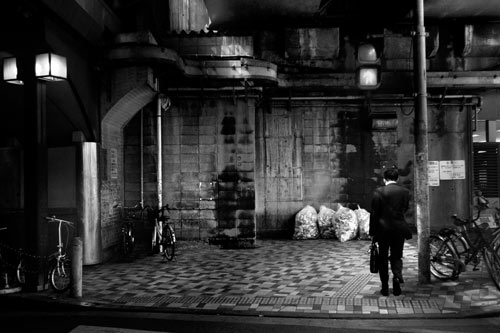
As ridiculous as it sounds, I realised today that I’d forgotten about telling stories through photography. Not completely, but over the past year there’d been a marked shift from my initial fascination with photojournalism to a lazy preoccupation with aesthetics (symptoms include, but are not limited to: spending an alarming number of afternoons idly sifting through ffffound and fistfuls of tumblrs).
And then I came across Reed Young’s work and it was so excellent and vibrant and best of all it reminded me that photos have the potential - through photojournalism and otherwise - to change the world. Idealistic, sure, but it's the best place to start from.
Here are some of my favourites from a image binge last year (the lack of hyperlinks attributable to the fact that this was before - gasp - I had a blog):
Tyler Hicks, The New York Times
Afghanistan. One suspect, who was later released, is marked with a number for identification purposes.
David Guttenfelder, The Associated Press
Japanese 'salary men' company employees gather after work in a gravel lot outside the Imperial Palace overlooking the financial district of Tokyo in September 2006. The loyal, black-suited cog of Japan Inc. 'the Salary Man' has been the symbol of Japan's post-war economic miracle.
But monotonous commutes, long days marked by emasculating work, absence from family, and the isolation of trying to get ahead in a business culture where individual achievement is frowned upon often makes the life of the Salary Man a lonely struggle.
Moving through the landscape of Tokyo like anonymous ghosts, the salary man is up at dawn for his two-hour train commute. His workday begins at 8:30 a.m., when the tardy bell sounds in his office. After an 11-hour day, there is obligatory excessive drinking and karaoke with superiors. The last train home leaves at midnight. Repeat.

Carolyn Cole, Los Angeles Times
The lifeless bodies of children killed by the Israeli bombing of Qana are rushed from the scene to waiting ambulances. At least 16 children were killed in the July 30th attack.
The Israeli-Hezbollah Conflict marked the beginning of a month-long battle between the Israeli military and Hezbollah forces after their abduction of two Israeli soldiers in a cross-border attack.
Few anticipated the intensity of the conflict as Israel responded with massive air strikes on Lebanon. Roads and bridges were destroyed, blocking the passage of many as they tried to flee the south. The sick, elderly, and poor were trapped in a nightmare, some without medicine, food or water.
In the end, 1,100 Lebanese civilians and 44 Israeli civilians were killed, along with hundreds of fighters on both sides. Although the buildings can be rebuilt, the human suffering and loss will remain.
Carolyn Cole, Los Angeles Times
Frightened children block their ears as people scramble to flee the city of Aaitaroun, where over one hundred people have been trapped by the bombing and damaged roads.
Christopher Anderson, Magnum for Newsweek
A Palestinian security force soldier lies wounded in the hospital after an attack by Hamas gunmen
Espen Rasmussen, Verdens Gang
Almost every building in Balakot was destroyed during the earthquake. Three months later, the inhabitants lives in tents and temporary houses.
Per-Anders Pettersson, Getty Images
Crew members wash Dola, a chimpanzee, that they bought for US$25 while waiting for their boat to leave the Kisangani port for the capital Kinshasa on March 4, 2006 in Kisangani, in Congo, DRC. Dola died a few days later from an unknown disease.
The Congo River is a lifeline for millions of people, who depend on it for transport and trade. The journey from Kisangani to Kinshasa is about 1750 kilometers, and it takes from 3-7 weeks on the river, depending on the boat. During the Mobuto era, big boats run by the state company ONATRA dominated the traffic on the river. These boats had cabins and restaurants etc. All the boats are now private and are mainly barges that transport goods.
The crews sell tickets to passengers who travel in very bad conditions, mixing passengers with animals, goods and only about two toilets for five hundred passengers. The conditions on the boats often resemble conditions in a refugee camp.
Congo is planning to hold general elections by July 2006, the first democratic elections in forty years.
Jan Dago, Jyllands-Posten/World Picture Network
Romania. Bucharest, Street children.
Bobo on the left is just turning 18. He tells me he has run away from home because of a violent father. The children pour toxic paint into plastic bags to inhale the fumes - this gives a quick high but the price is also severe brain damage.
This group of street children live in the heating channels that run under Bucharest. The heat down in the tunnels are intense and humid, the smell of human waste makes the stomach turn when one enters. The children are living down here because of the cold temperatures during winter in Rumania. They also try to avoid the risk of getting beaten or abused sexually if they try to sleep anywhere above the ground.
They tell me that the police also harass them, but that they have never seen any policemen who want to enter the heating tunnels.
They live from begging and from parking tips. Precise figures about how many street children there are in Romania is difficult to obtain, the range is from hundreds to 10,000.
Romania and Bulgaria became new members of the European union on the 1.1.07. The union now consists of 27 members and 480 million people. The two new members have been through turmoil during history. Romania is still marked by their diseased dictator Nicolae Ceausescu and his surreal leadership. Many countries have also been affecting Romania and Bulgarias development and the mindset of the population. The different involvement from other countries has left the two countries and the populations in a state of divide about what will happen to them when they enter the European union. Some fear that it will be a repetition of history, others are hopeful that the wealth of the other members will have a positive effect on the situation.
Life is already hard for the population in both countries. This makes it a nervous time of mixed hopes and fears of what will come for the people of Romania and Bulgaria.
Wissam Nassar, Maan News Agency

Damon Winter, Los Angeles Times
Family members console the mother of Israeli Army reservist David Amar at his funeral in Kiryat Shmona, Wednesday August 16, 2006.
Amar was killed a day before the cease-fire agreement ending fighting with Hezbollah in southern Lebanon.
Muhammed Muheisen, The Associated Press
Muslim pilgrims pray at Jabal Al Rahma holy mountain, the mountain of forgiveness, in Arafat outside Mecca, Saudi Arabia early.
More than 2 million Muslim pilgrims raised their hands to heaven and chanted in unison as they hiked through a dessert valley Sunday to a tent city on the outskirts of Mecca in preparation for the annual hajj.
Brian Hill, The Daily Herald
A St. Charles fire fighter carries the body of Chase, a two-year-old boy from the Fox River in South Elgin, IL, Thursday; July 27, 2006. The young boy had been missing for nearly three hours when the firefighters found him near the shore. Rescue personal were unable to save him.
Genaro Molina, The Los Angeles Times
Parts of Mardi Gras floats lie tattered and abandoned in a warehouse in New Orleans almost a year after Hurricane Katrina struck the Gulf Coast.
Jose Cendon, Freelance
A patient of the SOSAME (Soins de Sant Mentale) Neuro-Psychiatric hospital in Bukavu lies tied to a bed.
Stephen Katz, Freelance
Along the coast of Nigeria, where oil is king, an epidemic of cheating and corruption has bloomed. Among many scams, local kerosene merchants have begun to cut their product with gasoline, which is a few cents cheaper. The end result is that for a couple pennies of extra profit, unsuspecting Nigerians are sold tainted fuel for their lanterns and stoves which often explode, causing severe burns and death.
Emilio Morenatti, Associated Press
A Pakistani child looks on as women covered with burqas from the tribal region of Bajur and Mohmand agency wait to be registered at the Jalozai refugee camp near Peshawar, Pakistan on Friday, Jan. 30, 2009.

Armend Nimani, Agence France-Presse
A Kosovo Albanian woman looks out a window in the village of Babaj Bokes after sheep were slaughtered on May 6 2009 during the celebration of the traditional feast of Saint George’s Day, which is observed by several nations, kingdoms, countries, and cities of which Saint George is the patron saint.
Margaret Bourke-White, Getty Images
1937, Kentucky: Bourke-White captures one of America’s principle contradictions following the 1937 Ohio flood. Against a backdrop of wholesome affluence, the reality of American life is not quite as advertised, as African-Americans line up for relief.
Guillem Valle, Freelance
05/09/2009 - Mugumbano, South Kivu Province, Democratic Republic of Congo. A Congolese miner at the entrance of Mugumbano gold mine.
Rebel groups, government and mining companies exploit mineral resources, fuelling civil and interstate conflict as players vie for control over riches. Meanwhile, miners put their lives at risk on a daily basis to extract precious metals in order to obtain meagre economic compensation.
Reed Young's work is a lot more playful but equally as narrative driven:
Italian astrophysicist Margherita Hack, explaining to Federico why the sky is blue
Yasuyuki Hirose is a 32-year-old retired sumo wrestler who’s become famous in Japan for his part in a comedy trio that performs on TV. His obesity related difficulties are often the topic of the group’s jokes. In particular he’s known for being able to drink a two-litre bottle of orange Fanta in only ten seconds.